Gary Cohn is a former Goldman Sachs banker who washed into the Trump Administration when they were draining the swamp. He is presently the Director of the National Economic Council and at the top of most pundits’ list to succeed Janet Yellen as Chair of the Federal Reserve once her term ends in February 2018; or at least he was.
Cohn, who is Jewish, was standing next to Trump when Trump said that there were "fine people" marching among Nazis and KKK members. Cohn later gave an interview to the Financial Times where he said that “citizens standing up for equality and freedom can never be equated with white supremacists, neo-Nazis, and the KKK.” And, according to the Washington Post, has privately voiced his frustration and shock at Trump’s comments and even considered resigning. While it may seem standard for a politician to condemn hate groups, Cohn’s remarks reportedly angered Trump.
I imagine Cohn is a smart guy and knows a lot about finance, but he has no formal background in economics and no relevant experience in monetary economics. So I really hope his comments have reduced his chances to be in charge of the Federal Reserve. He is unqualified for that position.
Cohn’s reaction to Trump’s comments equating Nazis with anti-Nazis is how a non-bigot should react. So I guess he's better than other people in the administration. But Cohn still deserves the label of fascist collaborator. He expressed no qualms when the targets of Trump’s bigotry were Muslims, Latinos, Blacks, Asians, immigrants, women, etc. Only after Cohn felt a group he belongs to was the target did he find his conscious. Has he never encountered the Martin Niemöller quote? How is he shocked that Jews are also among the targets of the bigots who support the President he works for.
August 26, 2017

July 27, 2017
Collaborator watch: Jesse T. Richman, Gulshan A. Chattha, and David C. Earnest
Jesse Richman is a fascist collaborator. Why do I say that? First, Trump and his far right nationalist supporters are fascists. What else do you call such race/nationality based right wing extremism that scapegoats minorities and has no respect for independent institutions of government, a free press, etc.? Second, Jesse Richman and his co-authors, Gulshan Chattha and David Earnest, collaborate with them. They have done so through disingenuous research into voter fraud that finds that large numbers of non-citizens vote in US elections, despite the fact that no one else has come up with any evidence to support that claim. Voter fraud is extremely rare, non-citizen voter fraud even more so.
But any researcher who wants to make a name for themselves can come up with a junk science study to find otherwise. That’s exactly what Richman et al. did, and it worked. The paper was published in the journal Electoral Studies and received national attention. Jesse Richman has since been hired by Trump’s voter fraud commission to duplicate his dubious work for them. He is literally a collaborator with a far right white-nationalist (aka fascist) political movement.
So what makes their bullshit study such bullshit? Start with the sample size. They use an internet survey that had 32,800 respondents in 2008 and 55,400 in 2010. Sounds pretty big right? But non-citizens made up only 339 respondents in 2008 and 489 in 2010, or about 1% in each year. Non-citizens make up 7% of the population of the US. The survey made no attempt to get a representative sample of the US population writ large because the survey was designed for eligible voters, and non-citizens are not allowed to vote[1]. Despite this, the authors claim in their paper that the survey’s sample was “selected to mirror the demographic characteristics of the US population”. They must mean the population of eligible voters, because otherwise that is a lie. Elsewhere they state that “it is impossible to tell for certain whether the non-citizens who responded to the survey were representative of the broader population of non-citizens,” a severe understatement at best.
Of this small unrepresentative group, just under 20% claimed to have been registered to vote or were verified to be on voter registration rolls. The authors could only verify that a minority of that number were registered. Only 3.3% both claimed and were verified to be registered in 2008, and none in 2010. Some self-identified non-citizens claimed to not be registered to vote, but were verified to be registered. The authors leave out any details of the verification and use this finding to assume a higher number of non-citizens were registered than the survey responses and verification process indicated. For example, in 2008 67 non-citizens either reported or were verified to be registered; the authors assume 84 in their estimates.
Of this minority of non-citizen respondents, only a minority voted. In 2008 “71 non-citizens answered a survey question indicating whether they voted, and also had their vote validated. Among these, 56 indicated that they did not vote (but two of these cast a validated vote), while 13 indicated that they voted, of whom five cast a validated vote.” Notice how small the numbers are getting? They are using an un-representative sample size of less than a hundred people to reach conclusions about the voting behavior of millions. This is bullshit social science; that point is hard to understate.
The authors apply population weights so that their teeny tiny sample’s demographic characteristics match that of the non-citizen population as a whole. This is a perfectly reasonable technique when using a large enough sample size. On such a small sample it is unreliable at best. While the average characteristics of their sample may now match non-citizens as a whole it does not mean the distribution of survey responses will match the true figures for the larger population. Basically, their statistical techniques cannot overcome the flaws in their sample.
The authors conclude that “non-voter participation has been large enough to change meaningful election outcomes including Electoral College votes, and congressional elections.” How large? Their adjusted estimate is 6.4% of non-citizens in 2008 and 2.2% in 2010. Again, this is all based on an internet survey where 13 people out of 32,800 in 2008 said they were non-citizens and voted; only five of which could be confirmed. What are the chances that five to 13 people out of 32,800 clicked the wrong box on the citizenship or voting questions? The authors gloss over this and instead publish a highly flawed and prejudicial finding that falls apart upon the slightest scrutiny. A 2015 paper published in the same journal finds that observed levels of response error to the survey Richman et al. use can explain the entirety of their results.
Jesse Richman is now selling these dubious techniques to the Trump administration, where his latest finding that 18,000 non-citizens voted in Kansas was based on a sample size of 37. At best the authors wanted some limelight and were willing to slander a scapegoated minority to get it. Perhaps Jesse Richman and his co-collaborators are not hateful xenophobes and are just incredibly naïve. Perhaps they didn’t know they’d become the academic poster children of voter suppression. Whether bigots or fools they do not deserve the positions they hold at accredited universities. They should have known better than to publish such junk. That they did anyway speaks volumes as to their lack of ethical standards and/or lack of understanding of statistics.
An open letter signed by more than 150 political scientists states that “this paper has been shown to be incorrect”. Jesse Richman has offered numerous responses to the criticism on his blog.
But any researcher who wants to make a name for themselves can come up with a junk science study to find otherwise. That’s exactly what Richman et al. did, and it worked. The paper was published in the journal Electoral Studies and received national attention. Jesse Richman has since been hired by Trump’s voter fraud commission to duplicate his dubious work for them. He is literally a collaborator with a far right white-nationalist (aka fascist) political movement.
So what makes their bullshit study such bullshit? Start with the sample size. They use an internet survey that had 32,800 respondents in 2008 and 55,400 in 2010. Sounds pretty big right? But non-citizens made up only 339 respondents in 2008 and 489 in 2010, or about 1% in each year. Non-citizens make up 7% of the population of the US. The survey made no attempt to get a representative sample of the US population writ large because the survey was designed for eligible voters, and non-citizens are not allowed to vote[1]. Despite this, the authors claim in their paper that the survey’s sample was “selected to mirror the demographic characteristics of the US population”. They must mean the population of eligible voters, because otherwise that is a lie. Elsewhere they state that “it is impossible to tell for certain whether the non-citizens who responded to the survey were representative of the broader population of non-citizens,” a severe understatement at best.
Of this small unrepresentative group, just under 20% claimed to have been registered to vote or were verified to be on voter registration rolls. The authors could only verify that a minority of that number were registered. Only 3.3% both claimed and were verified to be registered in 2008, and none in 2010. Some self-identified non-citizens claimed to not be registered to vote, but were verified to be registered. The authors leave out any details of the verification and use this finding to assume a higher number of non-citizens were registered than the survey responses and verification process indicated. For example, in 2008 67 non-citizens either reported or were verified to be registered; the authors assume 84 in their estimates.
Of this minority of non-citizen respondents, only a minority voted. In 2008 “71 non-citizens answered a survey question indicating whether they voted, and also had their vote validated. Among these, 56 indicated that they did not vote (but two of these cast a validated vote), while 13 indicated that they voted, of whom five cast a validated vote.” Notice how small the numbers are getting? They are using an un-representative sample size of less than a hundred people to reach conclusions about the voting behavior of millions. This is bullshit social science; that point is hard to understate.
The authors apply population weights so that their teeny tiny sample’s demographic characteristics match that of the non-citizen population as a whole. This is a perfectly reasonable technique when using a large enough sample size. On such a small sample it is unreliable at best. While the average characteristics of their sample may now match non-citizens as a whole it does not mean the distribution of survey responses will match the true figures for the larger population. Basically, their statistical techniques cannot overcome the flaws in their sample.
The authors conclude that “non-voter participation has been large enough to change meaningful election outcomes including Electoral College votes, and congressional elections.” How large? Their adjusted estimate is 6.4% of non-citizens in 2008 and 2.2% in 2010. Again, this is all based on an internet survey where 13 people out of 32,800 in 2008 said they were non-citizens and voted; only five of which could be confirmed. What are the chances that five to 13 people out of 32,800 clicked the wrong box on the citizenship or voting questions? The authors gloss over this and instead publish a highly flawed and prejudicial finding that falls apart upon the slightest scrutiny. A 2015 paper published in the same journal finds that observed levels of response error to the survey Richman et al. use can explain the entirety of their results.
Jesse Richman is now selling these dubious techniques to the Trump administration, where his latest finding that 18,000 non-citizens voted in Kansas was based on a sample size of 37. At best the authors wanted some limelight and were willing to slander a scapegoated minority to get it. Perhaps Jesse Richman and his co-collaborators are not hateful xenophobes and are just incredibly naïve. Perhaps they didn’t know they’d become the academic poster children of voter suppression. Whether bigots or fools they do not deserve the positions they hold at accredited universities. They should have known better than to publish such junk. That they did anyway speaks volumes as to their lack of ethical standards and/or lack of understanding of statistics.
An open letter signed by more than 150 political scientists states that “this paper has been shown to be incorrect”. Jesse Richman has offered numerous responses to the criticism on his blog.
July 19, 2017
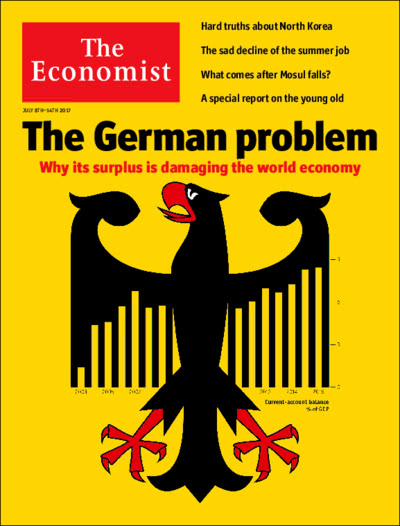
Appeaser Watch / The Economist Misses the Point
 |
| More like Appeasement, the British Problem |
I read the economist quite a bit. Their cover story an issue ago was one of the worst pieces of writing by the Economist since they advocated for the second Iraq war. They appease protectionist and mercantilism instincts with some very fuzzy logic, arguing that it is a bad thing that Germany has a current account surplus (basically a trade surplus). The title says "Why Its Surplus is Damaging the World Economy" but I read it and I still don't know.
The closest they come to explaining anything is:
"For a large economy at full employment to run a current-account surplus in excess of 8% of GDP puts unreasonable strain on the global trading system. To offset such surpluses and sustain enough aggregate demand to keep people in work, the rest of the world must borrow and spend with equal abandon."
Yes a current account surplus must be balanced out by deficits elsewhere, but why is it a bad thing for the rest of us that a surplus exists in one country? Again, a current account deficit in a country means it also has a capital account surplus (trade deficit means investment surplus, see prior post), so there's no net impact on GDP. Is this just some puritanical anti-debt instinct?
Their solution to the problem they can't fully explain seems to be for Germany to raise wages (which are set by the market and already among the fastest growing in the EU since the Great Recession) so that their exports are less competitive so that their neighbors can catch a break. Why isn't the solution for Germany's neighbors to reform (as Germany did in the late 1990s / early 2000s) and become more competitive? How would a less competitive Germany (such as it was pre-reform) be good for the world?
Anyway, Scott Sumner, one of my fav economists (as I've said before) beat me to this (again). So here's the highlights:
"The Economist confuses trade and aggregate demand, which are entirely unrelated issues...
We know that Italy, Greece, and Spain were not "forced" to run large deficits by Germany, because Italy and Spain have sizable surpluses, and Greece's current account is roughly balanced...
It's true that at a global level a German CA surplus must be offset by an equal deficit elsewhere. But the German economy is only a very small percentage of the global economy, so a Germany CA surplus of 8% of GDP implies a "rest of world" deficit of far less than 1% of GDP...
Even in a world with zero debt, there would be large and persistent CA imbalances as assets are bought and sold across borders."
Perhaps its noticeable, but international accounts is not a strong suite of mine. That's because of how little it matters. This kind of junk used to be important in the world of fixed exchange rates (such as the Gold Standard or the Bretton Woods System), where a change in the balance of a country's international accounts could force it to abandon its fixed exchange rate peg. But in a world of flexible exchange rates set by the market this stuff just takes care of itself and has no significant implications for anything. So from a global perspective Germany's trade surplus is insignificant.
However, the Euro area is a fixed exchange rate regime. This is the real issue that the Economist missed, instead they are freaking out about symptoms rather than the cause. If Germany and its Euro area trading partners had flexible exchange rates Germany's currency would most likely appreciate and its partners' depreciate, making Germany less competitive relative to them. The result would be a lower trade surplus for Germany. Instead Germany's Euro area trading partners can only become more competitive through structural reform or lower wages or the dumb suggestion that Germany make itself less competitive.
If there are any problems within the Euro zone due to Germany's trade surplus with the world, it is because of the fixed exchange rate regime. But even this may be meaningless; as noted above Italy and Spain also run surpluses despite being in a fixed exchange rate regime with Germany. So why is Germany's surplus a problem? The best answer I can find is that it isn't. Stop appeasing protectionists. Free trade forever.
June 30, 2017
More Economic Ignorance from Trump
Here's another horribly ignorant statement from Trump, during a Rose Garden ceremony with South Korea's president, concerning economics:
Let's start with the first statement. Yes, the US - South Korea trade deficit has gone up by about that much, at about the time the deal was implemented. The trade deficit in 2016 totaled $28 billion. That is a tiny deficit for an $18 trillion economy; it's a rounding error.
Now to the second. Anyone who took notes in their first macroeconomics class should know that a current account deficit is the equal opposite of a capital account surplus. What does that mean? The "current account" is a fancy term for the trade balance[1]. The "capital account" is the investment balance. As an accounting identity (of international flows of dollars that must net out) an international trade deficit means an international investment surplus. Why again? see note 2 below. Another way to put it is that we have an investment surplus with the world because we have a trade deficit, and vice versa.
The dollars that flow to South Korea for purchasing imports do not have to come directly back in the form of investment. South Korea may trade goods services and investments with other countries who then trade with us, balancing the flow of dollars out. This means it is possible for a country with no trade deficit / surplus in general to have a bilateral trade deficit / surplus with individual countries. It is illogical (and betrays basic ignorance of a topic Trump supposedly cares a lot about) to worry about bilateral trade balances trade, and equally illogical to be mad about a trade deficit and happy about an investment surplus[3].
Trump then goes on to highlight an export deal to South Korea worth almost the entire trade deficit, again underlining how small it is[4], and promises to pursue even freer trade with South Korea. What else is free trade besides seeking to "remove barriers to reciprocal trade and market access"?
So, if I've got this right, the free trade deal with South Korea was bad. But the South Korean investments it facilitated are good. Also South Korea is an export opportunity for american companies, and we should do more to remove trade barriers between the US and South Korea.
Um, what?
Populist/Nationalist economics makes no sense. It's just xenophobic knee jerk reactions. Now maybe it's expecting too much of a president to be this knowledgeable on every topic. That's why presidents have advisers. But this president has not even staffed the Council of Economic Advisers and has otherwise hired rich businessmen and populist hacks who have betrayed similar economic illiteracy[5]. Either they are plain stupid, out of their depth, afraid to contradict Trump, or have tried to teach him and given up[6]. Any of those would be concerning. The president has no idea what he's talking about and endorsing a mutually exclusive and incoherent mix of policy.
"From when the US Korea trade deal was signed in 2011 to 2016 - you know who signed it, you know who wanted it - our trade deficit with South Korea has increased by more than $11 billion, not exactly a great deal.
I was gratified to learn about the new investments South Korean companies are making in the United States.
This month Cheniere is sending its first shipment of American LNG to South Korea in a deal worth more than $25 billion. We will do more to remove barriers to reciprocal trade and market access."
Let's start with the first statement. Yes, the US - South Korea trade deficit has gone up by about that much, at about the time the deal was implemented. The trade deficit in 2016 totaled $28 billion. That is a tiny deficit for an $18 trillion economy; it's a rounding error.
Now to the second. Anyone who took notes in their first macroeconomics class should know that a current account deficit is the equal opposite of a capital account surplus. What does that mean? The "current account" is a fancy term for the trade balance[1]. The "capital account" is the investment balance. As an accounting identity (of international flows of dollars that must net out) an international trade deficit means an international investment surplus. Why again? see note 2 below. Another way to put it is that we have an investment surplus with the world because we have a trade deficit, and vice versa.
The dollars that flow to South Korea for purchasing imports do not have to come directly back in the form of investment. South Korea may trade goods services and investments with other countries who then trade with us, balancing the flow of dollars out. This means it is possible for a country with no trade deficit / surplus in general to have a bilateral trade deficit / surplus with individual countries. It is illogical (and betrays basic ignorance of a topic Trump supposedly cares a lot about) to worry about bilateral trade balances trade, and equally illogical to be mad about a trade deficit and happy about an investment surplus[3].
Trump then goes on to highlight an export deal to South Korea worth almost the entire trade deficit, again underlining how small it is[4], and promises to pursue even freer trade with South Korea. What else is free trade besides seeking to "remove barriers to reciprocal trade and market access"?
So, if I've got this right, the free trade deal with South Korea was bad. But the South Korean investments it facilitated are good. Also South Korea is an export opportunity for american companies, and we should do more to remove trade barriers between the US and South Korea.
Um, what?
Populist/Nationalist economics makes no sense. It's just xenophobic knee jerk reactions. Now maybe it's expecting too much of a president to be this knowledgeable on every topic. That's why presidents have advisers. But this president has not even staffed the Council of Economic Advisers and has otherwise hired rich businessmen and populist hacks who have betrayed similar economic illiteracy[5]. Either they are plain stupid, out of their depth, afraid to contradict Trump, or have tried to teach him and given up[6]. Any of those would be concerning. The president has no idea what he's talking about and endorsing a mutually exclusive and incoherent mix of policy.
June 7, 2017
Economic Related Incompetence
Here's a few funny economics-related items I'm late in commenting on that reflect how ignorant, incompetent, and out of depth the Trump administration is.
First, Trump thinks that he came up with the common economic stimulus metaphor "priming the pump". Here's the transcript from his interview with The Economist:
But beyond that it’s OK if the tax plan increases the deficit?
It is OK, because it won’t increase it for long. You may have two years where you’ll…you understand the expression “prime the pump”?
Yes.
We have to prime the pump.
It’s very Keynesian.
We’re the highest-taxed nation in the world. Have you heard that expression before, for this particular type of an event?
Priming the pump?
Yeah, have you heard it?
Yes.
Have you heard that expression used before? Because I haven’t heard it. I mean, I just…I came up with it a couple of days ago and I thought it was good. It’s what you have to do.
It’s…
Yeah, what you have to do is you have to put something in before you can get something out.
The "prime the pump" metaphor has been around since at least the Great Depression, back when people actually had to prime pumps. Trump is such an ignorant dumbass that he's never heard this common term before and he thinks he invented it recently, or he forgot he's heard it before and thinks it popped into his head because he's so clever.
Second, the White House Office of Budget and Management made a multi-trillion dollar math error that its director couldn't even catch, or admit to making afterwards. Basically, they assumed that their proposed tax cuts (estimated to cost trillions over a decade) would pay for themselves through induced higher economic growth. Which is nonsensically optimistic, but whatever.
So the tax cuts will supposedly generate growth required to make them deficit neutral. Then, to close a $1.3 trillion deficit by 2027 in Trump's budget proposal, they assume that tax cuts will increase economic growth enough to close the gap. Notice the problem? It's the same trick twice. How could the tax cuts be revenue neutral and increase revenue on net? Maybe they meant the tax cuts would be revenue positive, but they never made that claim. This is a very dumb, simple mistake. That it escaped the notice of everyone at OMB who laid eyes on it, including the director, further displays the utter incompetence of this administration.
May 25, 2017
OPEC Extends Production Cuts
AKA OPEC provides guidance to shale oil producers in the United States that they can continue to produce as much if not more oil and be about as profitable as they are now for at least nine more months.
April 20, 2017
April 14, 2017
Technology and Work part II: Economic Possibilities for our Grandchildren
Continued from Part I
What if this time is different? What if technology and automation create a world where human labor is uneconomical? What if we become so productive that there are too few jobs to go around? I’m pretty skeptical, but what if?
I’ll return to Keynes, in his 1930 essay:
Basically, too little work to go around due to efficient production? Great! Problem solved. This seems to be a fairly radical viewpoint; look at popular writings on automation and work, you would think it is a bad thing that robots could do our work for us. In reality, it would be a historic accomplishment. However, this long run outcome would raise its own, new problems.
As David Autor states in his recent paper:
I still can’t imagine a world where no human labor is needed at all. However, if human labor becomes uneconomical in production, we would have to rely on capital income (the return on ownership of robots for example). But capital ownership is highly concentrated. If we do not change our system in response to the effective elimination of wage income, our society would be split between rich capital owners, and an impoverished class with no ability to earn income beyond working for their own subsistence[2].
In short, in this what-if future, capitalism will cease to be the aggregate utility maximizing system and therefore must be discarded by economists (for the whole point of the science is to find the utility maximizing way to use our resources). Instead we would need to distribute ownership of capital (aka the means of production) among everyone, so that, in our future without scarcity, no one goes wanting.
Inequality would become unjustifiable as well. In 1944, the socialist economist Abba Lerner developed a simple equation of aggregate utility maximization, based on the concept of marginal utility. A poor person gains a greater marginal increase in utility from an additional dollar than a rich person. If you take that dollar from a rich person and give it to a poor person aggregate utility is therefore increased; this will go on until everyone has an equal amount of wealth.
What if this time is different? What if technology and automation create a world where human labor is uneconomical? What if we become so productive that there are too few jobs to go around? I’m pretty skeptical, but what if?
I’ll return to Keynes, in his 1930 essay:
“We are suffering just now from a bad attack of economic pessimism. It is common to hear people say that the epoch of enormous economic progress which characterised the nineteenth century is over[1]; that the rapid improvement in the standard of life is now going to slow down…I believe that this is a wildly mistaken interpretation…We forget that in 1929 the physical output was greater than ever before.
…the very rapidity of these changes is…bringing difficult problems to solve…namely…unemployment due to our discovery of means of economizing the use of labor outrunning the pace at which we can find new uses…But this is only a temporary phase of maladjustment. All this means in the long run that mankind is solving its economic problem.”
Basically, too little work to go around due to efficient production? Great! Problem solved. This seems to be a fairly radical viewpoint; look at popular writings on automation and work, you would think it is a bad thing that robots could do our work for us. In reality, it would be a historic accomplishment. However, this long run outcome would raise its own, new problems.
As David Autor states in his recent paper:
“if human labor is indeed rendered superfluous by automation, then our chief economic problem will be one of distribution, not of scarcity…we would have vast aggregate wealth but a serious challenge in determining who owns it and how to share it.”
I still can’t imagine a world where no human labor is needed at all. However, if human labor becomes uneconomical in production, we would have to rely on capital income (the return on ownership of robots for example). But capital ownership is highly concentrated. If we do not change our system in response to the effective elimination of wage income, our society would be split between rich capital owners, and an impoverished class with no ability to earn income beyond working for their own subsistence[2].
In short, in this what-if future, capitalism will cease to be the aggregate utility maximizing system and therefore must be discarded by economists (for the whole point of the science is to find the utility maximizing way to use our resources). Instead we would need to distribute ownership of capital (aka the means of production) among everyone, so that, in our future without scarcity, no one goes wanting.
Inequality would become unjustifiable as well. In 1944, the socialist economist Abba Lerner developed a simple equation of aggregate utility maximization, based on the concept of marginal utility. A poor person gains a greater marginal increase in utility from an additional dollar than a rich person. If you take that dollar from a rich person and give it to a poor person aggregate utility is therefore increased; this will go on until everyone has an equal amount of wealth.
The equation is true in and of itself, but it ignores human behavior and incentives. Nearly all economists regard some level of inequality as necessary to incentive economical behavior. For example, a sector that is producing too little given the demand for its output will have higher profits, enriching its capital owners relative to the rest of the economy but also incentivizing increased production.
But robots do not require such incentives; they can simply be programmed. Ownership of capital could be spread among all humans to do with what they want over their lives. And we could provide a basic income for those who still fuck up. This means humans can take greater risks in life, potentially incentivizing entrepreneurship rather than dependency. The consumption and savings choices of humans will still guide production to respond to human wants in a utility maximizing manner.
In a sense, we would all be rich, but even better. As Keynes put it (back in 1930 again):
But robots do not require such incentives; they can simply be programmed. Ownership of capital could be spread among all humans to do with what they want over their lives. And we could provide a basic income for those who still fuck up. This means humans can take greater risks in life, potentially incentivizing entrepreneurship rather than dependency. The consumption and savings choices of humans will still guide production to respond to human wants in a utility maximizing manner.
In a sense, we would all be rich, but even better. As Keynes put it (back in 1930 again):
“To judge from the behaviour and the achievements of the wealthy classes to-day in any quarter of the world, the outlook is very depressing! For these are, so to speak, our advance guard…they have most of them failed disastrously…to solve the problem which has been set them…
When the accumulation of wealth is no longer of high social importance…We shall be able to afford to dare to assess the money-motive at its true value. The love of money as a possession…will be recognised for what it is, a somewhat disgusting morbidity…
All kinds of social customs and economic practices, affecting the distribution of wealth and of economic rewards and penalties, which we now maintain at all costs, however distasteful and unjust they may be in themselves, because they are tremendously useful in promoting the accumulation of capital, we shall then be free, at last, to discard…
But beware! The time for all this is not yet. For at least another hundred years we must pretend to ourselves and to every one that fair is foul and foul is fair; for foul is useful and fair is not. Avarice and usury and precaution must be our gods for a little longer still. For only they can lead us out of the tunnel of economic necessity into daylight.”
April 12, 2017
Technology and Work part I: “The Bogeyman of Automation”
Technology in general, and advances in robotics and computing in particular, have created a lot of buzz and worries about what will happen to those whom[1] depend on wage income. “Maybe this time really is different” is the bare bones summary. Economists who air such views are sure to get a spot-light in our current political environment. But it is a view older than the Luddites. “This time is different” is a great way to get attention now, and look like an idiot in a decade or so, or at least it always has been[2]. Here’s an example of the popular worry about automation:
This is a pretty standard example of today’s worries, particularly the part about today’s new industries being different than in the past (think of the tech sector). Problem is that quote is from Time Magazine in 1961. It’s the same exact “this time is different” argument, except that we have the hindsight to know it was wrong. I vaguely remembered that Keynes wrote on this same subject so I went back and looked. Sure enough, in 1930 Keynes wrote (in an essay titled The Economic Possibilities for our Grandchildren):
It’s the same argument! Only by 1961 we had the hindsight to know it was wrong. Keynes correctly identified it as “only a temporary phase of maladjustment.” Since the 1960s (or 1930s for that matter), against the backdrop of higher productivity and women entering the labor force, employment has continued to grow. The employment-population ratio rose over the rest of the 20th century (it is now back to where it was in the mid-1980s due the recessions of this century and demographic change).
To address such concerns, the Johnson Administration formed a Commission on Technology, Automation, and Economic Progress. They hit the nail on the head:
Technology eliminates some jobs, but compliments others, increasing demand for such labor. And the typical job contains a mix of tasks, some of which are easily automated and others not. More generally, technology increases productivity, which means lower labor cost per unit of output. This will translate into a combination of increased production (because of lower costs), higher real incomes (because of lower real prices), and higher consumption (because of higher real incomes). All of which increase demand for labor. This is why the decline in agricultural employment in the US, from 41% of the labor force in 1900 to 2% by 2000 didn’t result in mass unemployment[3].
A frequent response to this simple, comforting story is that the costs and gains do not accrue evenly. Indeed technological innovation does cause inequality, particularly because cutting edge technologies are most expensive when new. In a recent paper, David Autor presents evidence that such worries are at least over-simplifications. While automation eliminates some low skilled jobs, robots cannot do everything a human can even at the bottom end of the skill distribution. As a result, automation increases the productivity of jobs at all skill levels. The rising incomes that result will cause people to consume more low skilled services.
Autor finds that over time employment increases across the skill spectrum typically have a U shape, though not always. That is, gains have been disproportionately at the ends of the spectrum[4]. However, because lower skilled jobs have lower barriers to entry (such as educational or licensing requirements), an increase in wages due to higher demand causes an increase in the quantity of labor supplied, subduing wage gains vs jobs with higher barriers to entry. Autor theorizes that middle skilled jobs have not seen as rapid growth because technological improvements are allowing automation to creep further up the skill ladder.
So the inevitable march of technology will not hit everyone equally, but it isn’t eliminating low skilled jobs opportunities generally. Some will lose while a majority benefit on net. The Luddites advocated destroying and banning technologies that threatened their livelihoods. Or, put another way, reducing the economy’s productive capacity, thus impoverishing wider society, in order to protect one class of labor from adjustment and competition. Surely there are better ways of helping the minority who lose out due to automation.
As Herbert Simon, a great economist and Nobel laureate, put it in the 1960s, “the world’s problems in this generation and the next are problems of scarcity, not of intolerable abundance. The bogeyman of automation consumes worrying capacity that should be saved for real problems.”
Part II
“The number of jobs lost to more efficient machines is only part of the problem…automation may prevent the economy from creating enough new jobs… But automation is beginning to move in and eliminate office jobs too… In the past, new industries hired far more people than those they put out of business. But this is not true of many of today’s new industries… Today’s new industries have comparatively few jobs.”
This is a pretty standard example of today’s worries, particularly the part about today’s new industries being different than in the past (think of the tech sector). Problem is that quote is from Time Magazine in 1961. It’s the same exact “this time is different” argument, except that we have the hindsight to know it was wrong. I vaguely remembered that Keynes wrote on this same subject so I went back and looked. Sure enough, in 1930 Keynes wrote (in an essay titled The Economic Possibilities for our Grandchildren):
“[I]n our own lifetimes…we may be able to perform all the operations of agriculture, mining, and manufacture with a quarter of the human effort to which we have been accustomed… the very rapidity of these changes is…bringing difficult problems to solve…namely…unemployment due to our discovery of means of economizing the use of labor outrunning the pace at which we can find new uses.”
It’s the same argument! Only by 1961 we had the hindsight to know it was wrong. Keynes correctly identified it as “only a temporary phase of maladjustment.” Since the 1960s (or 1930s for that matter), against the backdrop of higher productivity and women entering the labor force, employment has continued to grow. The employment-population ratio rose over the rest of the 20th century (it is now back to where it was in the mid-1980s due the recessions of this century and demographic change).
To address such concerns, the Johnson Administration formed a Commission on Technology, Automation, and Economic Progress. They hit the nail on the head:
“Thus technological change…is an important determinant of the precise places, industries, and people affected by unemployment. But the general level of demand for goods and services is by far the most important factor determining how many are affected…and how hard it is…to find jobs. The basic fact is that technology eliminates jobs, not work”.
Technology eliminates some jobs, but compliments others, increasing demand for such labor. And the typical job contains a mix of tasks, some of which are easily automated and others not. More generally, technology increases productivity, which means lower labor cost per unit of output. This will translate into a combination of increased production (because of lower costs), higher real incomes (because of lower real prices), and higher consumption (because of higher real incomes). All of which increase demand for labor. This is why the decline in agricultural employment in the US, from 41% of the labor force in 1900 to 2% by 2000 didn’t result in mass unemployment[3].
A frequent response to this simple, comforting story is that the costs and gains do not accrue evenly. Indeed technological innovation does cause inequality, particularly because cutting edge technologies are most expensive when new. In a recent paper, David Autor presents evidence that such worries are at least over-simplifications. While automation eliminates some low skilled jobs, robots cannot do everything a human can even at the bottom end of the skill distribution. As a result, automation increases the productivity of jobs at all skill levels. The rising incomes that result will cause people to consume more low skilled services.
Autor finds that over time employment increases across the skill spectrum typically have a U shape, though not always. That is, gains have been disproportionately at the ends of the spectrum[4]. However, because lower skilled jobs have lower barriers to entry (such as educational or licensing requirements), an increase in wages due to higher demand causes an increase in the quantity of labor supplied, subduing wage gains vs jobs with higher barriers to entry. Autor theorizes that middle skilled jobs have not seen as rapid growth because technological improvements are allowing automation to creep further up the skill ladder.
So the inevitable march of technology will not hit everyone equally, but it isn’t eliminating low skilled jobs opportunities generally. Some will lose while a majority benefit on net. The Luddites advocated destroying and banning technologies that threatened their livelihoods. Or, put another way, reducing the economy’s productive capacity, thus impoverishing wider society, in order to protect one class of labor from adjustment and competition. Surely there are better ways of helping the minority who lose out due to automation.
As Herbert Simon, a great economist and Nobel laureate, put it in the 1960s, “the world’s problems in this generation and the next are problems of scarcity, not of intolerable abundance. The bogeyman of automation consumes worrying capacity that should be saved for real problems.”
Part II
April 3, 2017
This week in “Duh” / Airing Grievances about the Occupy Movement
Micah White is some guy who was involved in getting the Occupy Wall Street fad up and running in 2011; other activists say the movement had no such founders. Anyway, in a shocking turn of events (six years later) White stated that the movement failed because it got caught up in the spectacle of its protests and didn’t get any closer to power or change much of anything.
Duh.
Duh.
This is a news story?
Sorry I’m not sorry, but even as someone with sympathy for and common ground with the movement, that was painfully obvious in real time. You mean camping in a park didn’t change our system? The whole movement got bogged down in an argument over whether people should be allowed to squat in a city park if they have a grievance. Basically they lost sight of the objective in an argument over tactics and eschewed “the system” in favor of ideological purity too much to have that wider impact. Maybe it just took this long for someone to interview White about this but I wish I could have met him six years ago and saved him the trouble.
Now White advocates running for office, which is laudable[1]. There needs to be some basic level of participation in our constitutional system in order to effectively advance any cause. But now he’s over large protest movements, saying he’s learned they are ineffective. So, because Occupy failed, all mass protest must be ineffective? This is a great way to dodge any responsibility for Occupy’s failure: the movement failed because it was impossible to succeed, not because of its own choices. History is full of examples of mass protest initiating significant, sometimes massive, change. Shit, just look at the Tea Party.
White, speaking for himself of course, had a lot of nice things to say about Trump in the same interview (also bad things, he’s no Trump supporter, just to be fair[2]). He’s an excerpt:
I don’t want to put words in the guy’s mouth[3] but it sounds like his disagreements with Trump are based on different political goals and not over the means Trump advocates to achieve them. If so, what an asshole. And he loves when Trump threatened violence if he didn't get his way? What an asshole. Anyway, White has a new book out called The End Of Protest: A New Playbook For Revolution. Based on what I’ve heard from him so far I’d say read it and do the opposite. Actually, just don’t read it.
Sorry I’m not sorry, but even as someone with sympathy for and common ground with the movement, that was painfully obvious in real time. You mean camping in a park didn’t change our system? The whole movement got bogged down in an argument over whether people should be allowed to squat in a city park if they have a grievance. Basically they lost sight of the objective in an argument over tactics and eschewed “the system” in favor of ideological purity too much to have that wider impact. Maybe it just took this long for someone to interview White about this but I wish I could have met him six years ago and saved him the trouble.
Now White advocates running for office, which is laudable[1]. There needs to be some basic level of participation in our constitutional system in order to effectively advance any cause. But now he’s over large protest movements, saying he’s learned they are ineffective. So, because Occupy failed, all mass protest must be ineffective? This is a great way to dodge any responsibility for Occupy’s failure: the movement failed because it was impossible to succeed, not because of its own choices. History is full of examples of mass protest initiating significant, sometimes massive, change. Shit, just look at the Tea Party.
White, speaking for himself of course, had a lot of nice things to say about Trump in the same interview (also bad things, he’s no Trump supporter, just to be fair[2]). He’s an excerpt:
“Donald Trump proves that it's possible for an outsider to win elections in America. So I celebrate him for that. I love his spirit. I love things that he said during the debates. I love his anti-establishmentism. I love that he says things like, before the election he said, ‘If I don't win the primary there's going to be riots in the streets.’ I love that. And I love Steve Bannon's Leninist spirit. I love all that stuff.”
I don’t want to put words in the guy’s mouth[3] but it sounds like his disagreements with Trump are based on different political goals and not over the means Trump advocates to achieve them. If so, what an asshole. And he loves when Trump threatened violence if he didn't get his way? What an asshole. Anyway, White has a new book out called The End Of Protest: A New Playbook For Revolution. Based on what I’ve heard from him so far I’d say read it and do the opposite. Actually, just don’t read it.
March 29, 2017
The Coal Jobs Aren't Coming Back

In light of Trump's recent photo ops about bringing coal jobs back, I thought I'd take the time to mention that no, they aren't. Certainly not unless the price of natural gas and oil rise significantly enough to offset their cost advantage. Given how successful fracking and other extraction innovations have been, such as horizontal drilling, that is highly unlikely. But even if those prices did rise, that still doesn't mean the jobs are coming back: most of them were lost to automation.
One of my fav economists, Scott Sumner has a great post laying out why the jobs aren't coming back (particularly in West Virginia, sorry). You should read that because when I read it I was like great, now I don't have to look up the data. But here are the two main take aways:
- Coal mining employment reached an all-time high in the early 1920s and has declined by over 85% since
- Coal production reached an all-time high in the late 2000s and has declined about 15% since
So from the 1920s to the 2000s coal production was growing while employment was shrinking, that was because automation made workers more productive (leading to wage gains), not because of regulations or foreign trade.
I don't mean to sound cavalier about an industry shedding jobs, but at least I'm not selling people false hope and lies. This is how the economy has always worked, old industries fade and new ones take their place. It's disingenuous for people to argue that the present difficulties (caused by inevitable change over time) are somehow new or different from the past, or that we need to take drastic actions to cope. This is especially true for coal where the vast majority of job loss had occurred by the 1960s. Prior generations were able to successfully deal with the same issues without electing a fascist demagogue, so that's a shit excuse.
Also when you add in the social cost of coal mining, from the contribution to climate change and detrimental effects on human health of mining and burning coal, the decline in coal production is not a net detriment to the economy overall (though local communities can be negatively impacted on net from this process).
March 17, 2017
Happy St. Patrick's Day
Happy holiday celebrating the Irish part of our country’s collective immigrant heritage. The Irish diaspora in the United States is over 30 million people, around seven times the population of Ireland itself. When Irish / Catholic immigrants first began arriving in significant numbers ignorant xenophobes said everything they now say about Middle Eastern / Muslim immigrants now. According to these privileged children of immigrants, the Irish were pre-disposed to violence and criminality, they lacked the skills needed to contribute, their religion was incompatible with religious liberty and the separation of church and state (as if that's what really bothers xenophobes), and they would not and could not be assimilated into the nation as previous waves of immigrants had.
But looking back we know it was just irrational bullshit. Now the Irish are considered White by society and we don’t notice the differences anymore. And the Irish didn’t go back where they came from. The nation assimilated to the Irish as much as the other way around; absorbing new immigrants doesn’t displace our culture, it expands it.
But looking back we know it was just irrational bullshit. Now the Irish are considered White by society and we don’t notice the differences anymore. And the Irish didn’t go back where they came from. The nation assimilated to the Irish as much as the other way around; absorbing new immigrants doesn’t displace our culture, it expands it.
The modern wave of immigrants aren’t going anywhere either and they will inevitably and irreversibly change our country for the better. So to all the dumbass xenophobes out there, your world is dying and the spray-tanned asshole you elected won’t be able to stop it. And as an Irish American, let me say to Trump supporting Irish Americans, on behalf of those of us who know our history in this country: shame on you, you sold out the principles that let us escape tyranny and thrive in this country despite people much like yourselves. And we're supposed to think that today’s immigrants, the most recent arrivals in a centuries-long flow, are the threats to our system and values?
February 9, 2017
In the 80s
Jeff Sessions was too racist to be a judge and Black Flag wrote this:
We're gonna be a white minority
We won't listen to the majority
We're gonna feel inferiority
We're gonna be a white minority
We're gonna be a white minority
We won't listen to the majority
We're gonna feel inferiority
We're gonna be a white minority
The Apology Tour Finally Arrives
As has gotten a bit of media attention recently, Bill O'Reilly, one of the grumpy old white men on Fox News, asked Trump why he respects Putin despite Putin being "a killer."
Trumps (abridged) response: "What you think our country is so innocent?"
Looks like the apology tour that Republicans promised us Obama was on has finally gotten started. I predict that Republicans will be at least as outraged due to the fact that they threw a fit even though Obama never went on the apology tour (he did go on a bombing tour though, maybe the bombs said "sorry" on them). Oh wait, the president's party and skin color are different this time. Republicans will keep quite like a child that doesn't want to attract a bully's attention by standing up for others.
Trumps (abridged) response: "What you think our country is so innocent?"
Looks like the apology tour that Republicans promised us Obama was on has finally gotten started. I predict that Republicans will be at least as outraged due to the fact that they threw a fit even though Obama never went on the apology tour (he did go on a bombing tour though, maybe the bombs said "sorry" on them). Oh wait, the president's party and skin color are different this time. Republicans will keep quite like a child that doesn't want to attract a bully's attention by standing up for others.
January 28, 2017
Natural Monetary Experiments
In early November, the Prime Minister of India, Narendra Modi, declared that all 500 and 1,000 rupee notes would cease to be legal tender by the end of 2016 ($1 is worth about 68 rupees). Those two notes made up 86% of all cash by value, in an economy where more than 90% of transactions occur in cash. Those holding 500 and 1,000 rupee notes had exchange them for other, or new, denominations of cash, or deposit them in a bank. But anyone who exchanged a large amount was audited. The intent was to devalue illicit wealth held in cash, increase the state’s tax take, and “modernize” the economy by transferring activity away from cash transactions and into the formal financial sector.
In the short run, the effect will be a significant decrease in the money supply and a reduction in aggregate demand, ceteris paribus. In the long run, money is neutral: an increase or decrease in its supply will lead to inflation or deflation, respectively, with no change to the real value of anything. But in the short run money is non-neutral, owning to phenomenon such as sticky prices and imperfect information. Therefore a contraction in the money supply reduces growth in the short run, and vice versa. The size and duration depends on how quickly the government can replace the old denominations, which began to lose value after the announcement as businesses did not want accept payments in soon-to-be-worthless money. This led to a seizing up of economic activity, as businesses across supply chains struggle to make acceptable payments to their suppliers. Large lines formed at banks and withdraw limits were put in place.
The mal-effects of monetary contraction will hurt the poor, who rely most heavily on cash, the most. While switching to a bank account is a practical solution for some, fewer than 35% of Indians over 15 use a bank account. Unsurprisingly the poor have the least access to banking and non-cash payment methods.
And it is unlikely the rich hiding wealth from tax authorities hold much of it in cash; more likely it is held in assets such as overseas properties and investments that will be unaffected. By the end of the year nearly all the currency in question had been deposited in a bank and validated as legitimately earned (that or well-laundered). The government replaced many of the old notes with new 500 and 2000 rupee notes; holding illicit wealth in cash will be at least as easy once the transition is complete.
Further out, the increase in bank deposits will lead to an increase in bank lending, thus expanding the money supply and the proportion of economic activity that is within the reach of the tax authorities. Maybe the risky gambit will pay off, my guess is not really. But there are many regulatory impediments to expanding banking to the poor and/or rural residents, which is why so few people use banks in the first place. Reducing such barriers would have the same benefits with less risk.
So far the reaction has been as those economists who believe money is non-neutral in the short run would have predicted. And it is a blow to those economists who rely on mathematical identities (in this case MV=PY [1], which it does in long run equilibrium) over real world observation. The non-neutrality of money means that monetary policy does have the ability to increase or decrease real aggregate demand in the short run, rather than just affect nominal prices. To what degree real economic activity is affected depends on the slope of the aggregate demand curve.
As if to one-up India’s actions, Venezuela’s incompetent president, Nicolás Maduro, announced on December 11th, 2016 that the 100 bolivar note (worth about three cents and falling fast), which accounts for 77% of the country’s cash by value, would become worthless in 72 hours. Businesses refused to accept them almost immediately. The notes are to be replaced with higher denominations (inflation will soon surpass 200%), which weren’t readily available. As of the following weekend, ATMs still spit out worthless 100 bolivar notes. The reason given by the government is somewhat similar to India’s justification: to devalue the illicit wealth held by “mafias” that supposedly hoard bolivars, which the government says is leading to shortages in Venezuela. This is ludicrous. Nobody who has any options would hold their wealth in a currency whose value is plummeting, and if mafias were really hoarding vast amounts of bolivars the effect would be deflationary. The shortages are instead caused by the government’s horrible economic policies, including price controls.
Then on December 18th, after widespread protest, Maduro backed down. Venezuelans were given until January 2nd to exchange their 100 bolivar notes. Then, towards the end of December the deadline was delayed to late January. The fact that the government didn’t have replacement notes ready before announcing the decision played a part in the reversal. But the government can’t un-ring the bell. The 100 bolivar note is still slated to be worthless soon, so its real value, and confidence in the monetary system, will still be reduced. Given the massive monetary expansion in years past (the actual source of inflation) Venezuela needs to reduce the growth of the money supply, which would tame inflation at the cost of short run pain. A less extreme but similar example is the US in the late 1970s, when Fed Chair Paul Volker reduced the rate of money supply growth (which led to higher interest rates in the short run and lower rates in the long run), causing a recession but taming inflation.
The US, Euro Zone, and Singapore, to name a few, have all taken high denominations of cash out of circulation in the past, often citing similar reasons. But there are more or less right ways to do such things, while Venezuela is plumbing the depths of mismanagement.
In the short run, the effect will be a significant decrease in the money supply and a reduction in aggregate demand, ceteris paribus. In the long run, money is neutral: an increase or decrease in its supply will lead to inflation or deflation, respectively, with no change to the real value of anything. But in the short run money is non-neutral, owning to phenomenon such as sticky prices and imperfect information. Therefore a contraction in the money supply reduces growth in the short run, and vice versa. The size and duration depends on how quickly the government can replace the old denominations, which began to lose value after the announcement as businesses did not want accept payments in soon-to-be-worthless money. This led to a seizing up of economic activity, as businesses across supply chains struggle to make acceptable payments to their suppliers. Large lines formed at banks and withdraw limits were put in place.
The mal-effects of monetary contraction will hurt the poor, who rely most heavily on cash, the most. While switching to a bank account is a practical solution for some, fewer than 35% of Indians over 15 use a bank account. Unsurprisingly the poor have the least access to banking and non-cash payment methods.
And it is unlikely the rich hiding wealth from tax authorities hold much of it in cash; more likely it is held in assets such as overseas properties and investments that will be unaffected. By the end of the year nearly all the currency in question had been deposited in a bank and validated as legitimately earned (that or well-laundered). The government replaced many of the old notes with new 500 and 2000 rupee notes; holding illicit wealth in cash will be at least as easy once the transition is complete.
Further out, the increase in bank deposits will lead to an increase in bank lending, thus expanding the money supply and the proportion of economic activity that is within the reach of the tax authorities. Maybe the risky gambit will pay off, my guess is not really. But there are many regulatory impediments to expanding banking to the poor and/or rural residents, which is why so few people use banks in the first place. Reducing such barriers would have the same benefits with less risk.
So far the reaction has been as those economists who believe money is non-neutral in the short run would have predicted. And it is a blow to those economists who rely on mathematical identities (in this case MV=PY [1], which it does in long run equilibrium) over real world observation. The non-neutrality of money means that monetary policy does have the ability to increase or decrease real aggregate demand in the short run, rather than just affect nominal prices. To what degree real economic activity is affected depends on the slope of the aggregate demand curve.
As if to one-up India’s actions, Venezuela’s incompetent president, Nicolás Maduro, announced on December 11th, 2016 that the 100 bolivar note (worth about three cents and falling fast), which accounts for 77% of the country’s cash by value, would become worthless in 72 hours. Businesses refused to accept them almost immediately. The notes are to be replaced with higher denominations (inflation will soon surpass 200%), which weren’t readily available. As of the following weekend, ATMs still spit out worthless 100 bolivar notes. The reason given by the government is somewhat similar to India’s justification: to devalue the illicit wealth held by “mafias” that supposedly hoard bolivars, which the government says is leading to shortages in Venezuela. This is ludicrous. Nobody who has any options would hold their wealth in a currency whose value is plummeting, and if mafias were really hoarding vast amounts of bolivars the effect would be deflationary. The shortages are instead caused by the government’s horrible economic policies, including price controls.
Then on December 18th, after widespread protest, Maduro backed down. Venezuelans were given until January 2nd to exchange their 100 bolivar notes. Then, towards the end of December the deadline was delayed to late January. The fact that the government didn’t have replacement notes ready before announcing the decision played a part in the reversal. But the government can’t un-ring the bell. The 100 bolivar note is still slated to be worthless soon, so its real value, and confidence in the monetary system, will still be reduced. Given the massive monetary expansion in years past (the actual source of inflation) Venezuela needs to reduce the growth of the money supply, which would tame inflation at the cost of short run pain. A less extreme but similar example is the US in the late 1970s, when Fed Chair Paul Volker reduced the rate of money supply growth (which led to higher interest rates in the short run and lower rates in the long run), causing a recession but taming inflation.
The US, Euro Zone, and Singapore, to name a few, have all taken high denominations of cash out of circulation in the past, often citing similar reasons. But there are more or less right ways to do such things, while Venezuela is plumbing the depths of mismanagement.
Subscribe to:
Posts (Atom)